Table Of Content
- Indonesia’s Harimau Tank Commissioned: Revolutionizing Modern Warfare
- The Reasons Behind Iran’s Attack on Israel
- T-38 Talon: a chapter that closes in the history of military aviation
- Ballistic missiles are broadly categorized into four groups based on their range:
- Propulsion and Flight
- Depressed trajectory
Between 1957 and 1961 the United States followed an ambitious and well-funded program to develop a nuclear-powered cruise missile, Supersonic Low Altitude Missile (SLAM). It was designed to fly below the enemy's radar at speeds above Mach 3 and carry hydrogen bombs that it would drop along its path over enemy territory. Although the concept was proven sound and the 500-megawatt engine finished a successful test run in 1961, no airworthy device was ever completed. As technology advances, the horizon holds promises of more intelligent, self-managing, and hypersonic cruise missiles entering the global market. Irrespective of these changes, cruise missiles are poised to endure as one of the most dependable weapons in the foreseeable future.
Indonesia’s Harimau Tank Commissioned: Revolutionizing Modern Warfare
While immensely accurate, this method can be vulnerable to interference from environmental factors such as dust and smoke, potentially hindering target acquisition. This intricate mechanism involves the comparison of an onboard terrain map with the actual topography over which the missile traverses. This technique guarantees the missile’s adherence to the designated path, further reinforcing its accuracy and operational efficacy.
The Reasons Behind Iran’s Attack on Israel
Nonetheless, several other countries have produced them; among these are the United Kingdom, France, China, Pakistan, Israel, Iran, South Korea, and North Korea. Also, as with any technology, there has occurred a transfer of ballistic missile technology to less-developed countries. Combined with the widespread capacity to produce chemical warheads, such weapons represent a potent addition to the arsenals of emerging powers of the developing world.
T-38 Talon: a chapter that closes in the history of military aviation
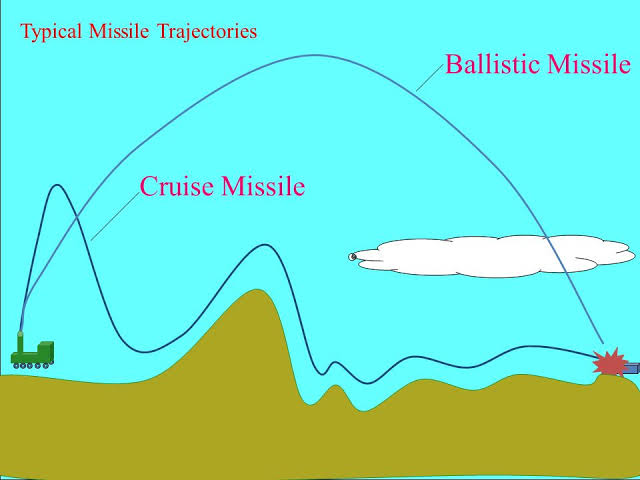
Cruise missiles are self-propelled for the majority of their time in the air, flying in a relatively straight line and at lower altitudes thanks to a rocket propellant. Think of a ballistic missile's flight path as a large arc up and back down again, while that of a cruise missile — fired from a warship, for instance — is closer to a straight line. Due to its high accuracy, cruise missiles are often equipped with conventional warheads. Meanwhile, ballistic missiles are often equipped with nuclear warheads, enough to destroy the target even though the accuracy is not high. The United States, Russia, North Korea, India, Iran, South Korea, Israel, France, China and Pakistan have developed several long-range subsonic cruise missiles.
Terrain Contour Matching (TERCOM): Navigating with Terrain
What that means is that once the missile burns up the fuel that propels it, the missile keeps moving, the same way that a bullet does after it's been fired out of a gun. It follows a path determined by the speed of its launch and the force of gravity trying to pull it back toward the Earth's surface. Eventually, gravity guides the missile — and its payload, which might be an explosive, a chemical or biological weapon, or a nuclear device — down toward its target.
Their very high speed in the ballistic phase also makes them harder to intercept and destroy, even if they are easily detected. For these reasons, cruise missiles have not replaced ballistic missiles for carrying nuclear weapons at long range even if cruise missiles provide better precision and are harder to detect due to their low altitude trajectory. Nevertheless, the cost of developing ballistic missiles and the infrastructure they require make them much more expensive than cruise missiles. While ballistic missiles were the preferred weapons for land targets, heavy nuclear and conventional weapon tipped cruise missiles were seen by the USSR as a primary weapon to destroy United States naval carrier battle groups.
Things got real, though, on Jan. 7, 2020, when Iran launched more than a dozen ballistic missiles at two Iraqi military bases housing U.S. troops. It was Iran's retaliation for the U.S. drone strike that killed Iran Gen. Qassem Soleimani on Jan. 3, 2020. There were no casualties and Iran's Foreign Minister Mohammad Javad Zarif defended the missile strike on the U.S. bases in Iraq, saying it was an act of "self-defense." Ballistic missiles on the other hand are not powered during most of their flight.
Propulsion and Flight
What Iran's attack on Israel revealed about its weapons arsenal - The Washington Post
What Iran's attack on Israel revealed about its weapons arsenal.
Posted: Wed, 17 Apr 2024 21:58:00 GMT [source]
Cruise missiles harness a repertoire of guidance methods to ensure the impeccable placement of their payloads on intended targets while outmaneuvering missile defense systems. Among these methods, inertial guidance stands as a foundational approach, relying on a pre-programmed flight path set before launch. Cruise missiles can reach their objectives from a variety of altitudes so long as they remain within the atmosphere. The trajectory of the vast majority of objects remains close to the Earth’s surface, occasionally hovering just meters above the ground.
Cruise missiles are self-propelled, guided weapons that can be launched from various platforms, including aircraft, ships, or ground-based launchers. They are designed to fly at low altitudes and can be programmed to follow a specific flight path, often hugging the terrain, which makes them difficult to detect and intercept. Cruise missiles can carry various types of warheads and are used for precise, long-range strikes on specific targets, such as military installations, infrastructure, or high-value targets. Their ability to navigate and adapt during flight provides them with a high degree of accuracy.
These systems necessitate connectivity with the GPS or GLONASS satellite networks and facilitate adherence to predetermined flight paths. Cruise missiles can strike designated targets with unparalleled precision by leveraging specific coordinates, augmenting their role in modern warfare. According to Wikipedia, short-range ballistic missiles stay within the Earth’s atmosphere, while intercontinental ballistic missiles (ICBMs) are launched on a sub-orbital trajectory. Guided cruise and ballistic missiles were first used when Germany attacked targets in England and Northern Europe with V1 cruise missiles and V2 ballistic missiles during World War II. Although these missiles were inaccurate, their use resulted in tens of thousands of Allied casualties. The North Korean regime successfully tested intercontinental ballistic missiles (ICBM) in July and November 2017.
The United States, which feared an Israeli retaliation could have compelled the Arab states in the multinational coalition Washington had formed to confront Iraq to withdraw, tried to reassure Israel by deploying Patriot missiles to bolster its air defenses. However, those earlier Patriot models proved largely ineffective against the Iraqi Scuds. Kelsey D. Atherton is a military technology journalist who has contributed to Popular Science since 2013. He covers uncrewed robotics and other drones, communications systems, the nuclear enterprise, and the technologies that go into planning, waging, and mitigating war. Zahedi was the most senior Iranian military official assassinated since the U.S. killed Qassem Soleimani in a Baghdad drone strike in January 2020.

A Ballistic Missile is lift off directly into the high layers of the earth’s atmosphere. These missiles travel faster than the speed of sound, usually using ramjet engines. Cruise missiles can be categorized by payload/warhead size, speed, range, and launch platform.
In the interest of brevity, you can really sum up the difference between these types of weapons with the trajectory that they follow. A ballistic missile follows a “ballistic flight path,” which often includes traveling along a long arc, whereas a cruise missile tends to follow a straighter, lower altitude trajectory. Another easy (if not exactly precise) way to think about them is that ballistic missiles are more like rockets, while cruise missiles are more like aircraft or drones. Cruise missiles are guided, jet or propeller-driven projectiles that can fly at low altitudes, follow a flexible path, and are capable of precision strikes. Ballistic missiles, on the other hand, are unguided, rocket-powered weapons that follow a high, arching trajectory before descending toward their target. They are typically much faster and have longer ranges, but they lack the in-flight manoeuvrability of cruise missiles, making them more suitable for long-range and strategic strikes.


No comments:
Post a Comment